← Back to Projects

n8n-Powered Enterprise Meeting Automation Ecosystem

Project Overview: Automation Transformation

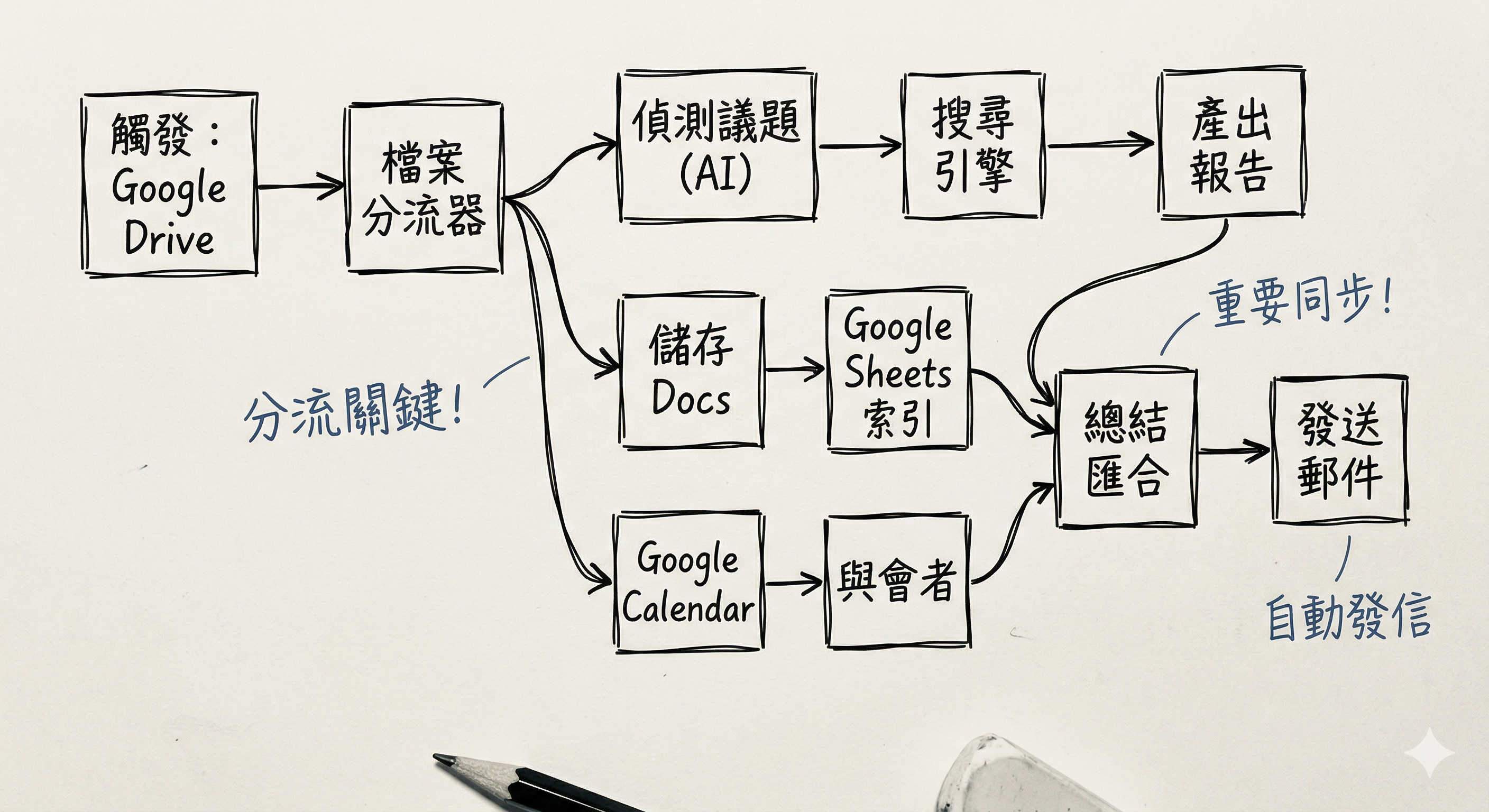
This project aims to eliminate the "time-consuming and repetitive" pain points of meeting documentation. By integrating Google Workspace and OpenAI via n8n, I developed an end-to-end automated workflow covering file detection, meeting summarization, research report generation, and participant-targeted emailing.

Despite hardware constraints (utilizing an aging PC as a server), the project successfully overcame technical hurdles such as multi-format compatibility, timezone synchronization, and complex semantic matching. The solution successfully streamlined a 1-hour manual process into an automated task completed in under 3 minutes, maximizing operational efficiency.
Core Pain Point Analysis

The traditional meeting workflow faced several major efficiency barriers:

  • Manual Effort: Summarizing a 1-hour meeting typically takes 45–60 minutes, with a high risk of missing critical details.
  • Information Silos: Transcripts, minutes, and calendar data are disconnected, requiring manual mapping of participants for email distribution.
  • Post-meeting Research Overhead: Action items requiring further research must be manually searched, synthesized, and reported after the session.
  • Technical Format Barriers: Binary files such as .docx and .pdf cannot be directly ingested by AI, and standard nodes often produce encoding errors (e.g., "PK" headers) during analysis.

Requirement Definition

To ensure the automated solution delivered maximum value, four core system requirements were defined prior to launch:

  1. Cross-format Data Processing: The system must handle diverse sources, including Audio, PDF, .docx, Google Docs, and .txt, ensuring seamless data ingestion.
  2. Automated Deliverables: Based on discussions, the system must dynamically generate high-quality meeting minutes, thematic research reports, and tailored email drafts.
  3. Cloud Governance & Traceability: All outputs must be synchronized to the cloud and indexed in a centralized list to ensure long-term auditability and tracking.
  4. Operational Cost Optimization: Implementing a "Strategic Allocation" principle, LLM APIs are only triggered for critical cognitive tasks to minimize token consumption and optimize resources.
Workflow Architecture: A 4-Stage Modular Design

Workflow Architecture: A 4-Stage Modular Design

To ensure operational stability and output precision, the workflow is architected into four functional segments:

  1. Trigger & Dynamic Routing: Performs real-time monitoring of cloud folders and executes intelligent routing based on file types (Audio, Word, PDF) to prepare data for downstream nodes.
  2. Topic Analysis & Automated Research: Utilizes AI to detect researchable subjects within minutes, triggers web-search integration, and synthesizes comprehensive research reports.
  3. Information Management & Archiving: Synchronizes summaries as Google Docs, queries attendee records via the Calendar API, and logs meeting indices into Google Sheets for tracking.
  4. Stakeholder Communication Automation: Employs "Multi-branch Consolidation" logic to aggregate minutes and reports, drafting and distributing professional post-meeting summary emails.
Agile Execution Process: From Hardware Deployment to System Integration

Agile Execution Process: From Hardware Deployment to System Integration

The project followed a Scrum Agile framework across four Sprints to ensure flexibility and validation:

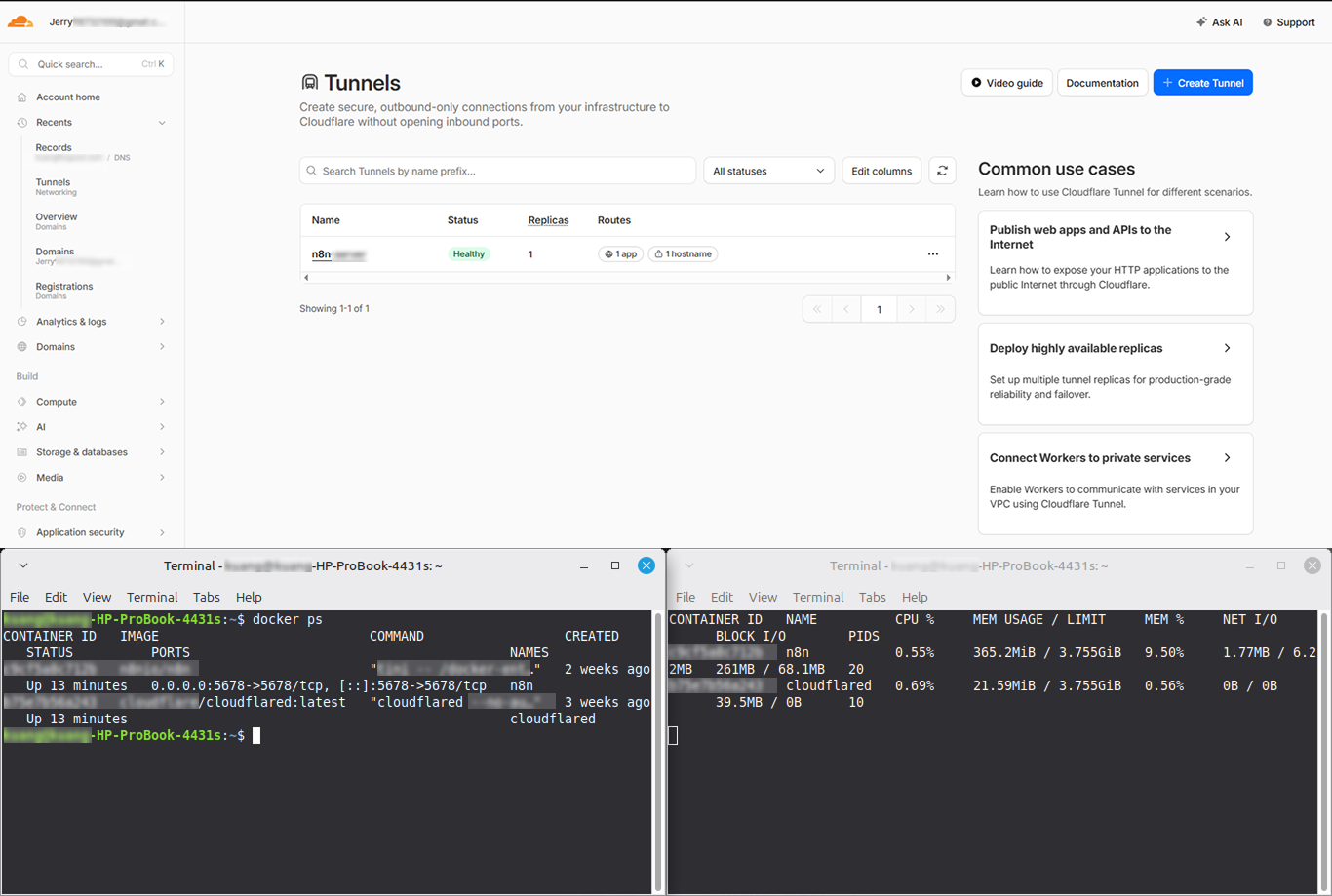
  • Sprint 1 - Infrastructure & Server Deployment: Repurposed a legacy PC as a local edge server and implemented Cloudflare Tunnels to bypass firewalls, achieving a 24/7 automated hosting environment.
  • Sprint 2 - Authentication & Data Standardization: Configured API credentials (OAuth2), established Google Drive triggers, and developed routing protocols to ensure diverse inputs met system standards.
  • Sprint 3 - Intelligence & Node Optimization: Focused on AI logic and Prompt Engineering to refine OpenAI outputs, ensuring professional-grade quality for all deliverables.
  • Sprint 4 - Testing & Automated Maintenance: Verified stability using multi-source test data, implemented "Path Isolation" logic to prevent infinite trigger loops, and engineered automated garbage collection for temporary files.

Technical Bottlenecks & Resilience: Turning Challenges into System Assets

The development journey faced two major technical hurdles that served as catalysts for growth:

  • Timezone & ID Precision: Faced an issue where calendar queries returned null values. This was resolved by manually calibrating the ISO Offset and correcting a character-level discrepancy between the digit '0' and the letter 'O' within the API IDs.
  • Disaster Recovery & Standardization: A mid-project environment shift led to the accidental deletion of server configurations. I pivoted this setback into an opportunity to codify fragmented settings into a Deployment SOP and build an automated backup workflow, elevating the system from a "prototype" to a "professional-grade" standard.

Project Impact & Quantitative Results

The implementation of this system yielded significant results in efficiency, communication, and cost control:

  1. Efficiency Revolution: End-to-end processing time for a single meeting was reduced from 1 hour to under 3 minutes (a 95% increase in efficiency).
  2. Seamless Sync & Traceability: Automated archiving and stakeholder notification established a transparent decision-tracking framework, improving document accessibility.
  3. Instant Intelligence Delivery: Enabled active topic detection; stakeholders now receive in-depth research reports immediately post-meeting, accelerating the strategic execution cycle.
  4. Low-cost Sustainability: Successfully repurposed legacy hardware for a complex system, achieving Zero-CapEx infrastructure while maintaining a "Zero-Clutter" cloud environment via automated cleanup.